


Mobile BSPB teams provide easy and safe food for the Egyptian vultures
16.05.2012- Home
- Useful information
- Mobile BSPB teams provide easy and safe food for the Egyptian vultures
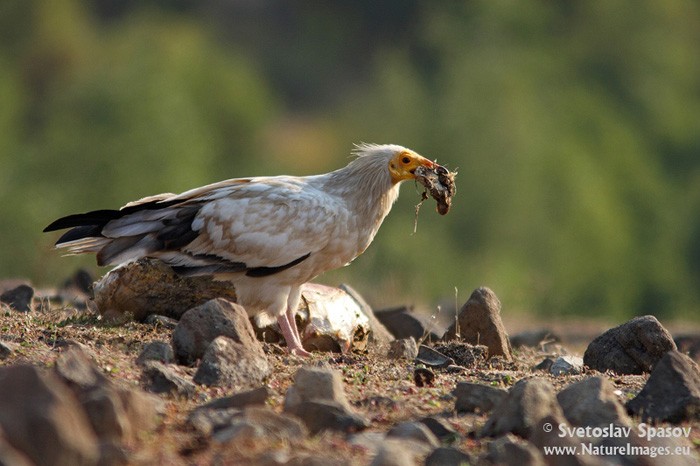
Recently the team of the Return of the Neophron project funded by the LIFE+ Programme of the EU and the A. G. Leventis Foundation launched a key conservation activity – feeding of the Egyptian vultures in the region. The activity is aimed at improving the diet of breeding pairs of the globally threatened species, as insufficient food sources are among the main reasons for the unsuccessful breeding of the vultures.
The feeding will also provide safe food – free from substances harmful to the birds: high concentration of antibiotics, heavy metals etc. The meat for the feedings has a controlled origin and proven quality. The terrestrial scavengers of the vultures’ food have been avoided by means of four feeding platforms (two in Bulgaria, two in Greece) mounted on trees. At present 6 pairs of Egyptian vultures are being fed in Bulgaria using this technique.
Experts from BSPB assess which pairs are in the biggest need of additional feeding through species monitoring within the Neophron project. For example, the male in one of the pairs in northern Bulgaria seemed to ignore his duties as a father and rarely replaced the female in the nest. The feeding provides her with a food supply close-by so she doesn’t have to leave the nest for too long ( the unprotected eggs can easily be destroyed by crows, or cool down if the parent stays away for too long). The greatest joy for the team is to see their efforts rewarded: in this case the female happily accepted the food and on some days fed up to three times a day.
Another good example is a pair from southern Bulgaria. With the start of the feeding programme the female laid eggs after the pair didn’t breed for several years.
Alas, our efforts do not always have a successful end. The northernmost breeding pair of Egyptians in Bulgaria was included in the programme following the disappearance of the male vulture two weeks ago. The female bird continued to care for the eggs, and the feeding was meant to shorten her absence from the nest when looking for food. Unfortunately despite the efforts of our team the absence of the male had its toll and a few days ago we discovered the eggs in the nest broken.
For more information:
Vladimir Dobrev
Conservation Officer
for The Return of the Neophron project LIFE10 NAT/BG/000152
e-mail: vladimir.dobrev@bspb.org

Back

The breeding performance of the Egyptian Vulture population in Bulgaria is among the highest in Europe


 iordanka.goranova@bspb.org
 +359 (02) 979 95 00


